
 Monitoring
A Service That Alerts Parents About Dangerous Conversations
A service that warns parents about dangerous conversations is useful only if it reports the conversation itself — a chat or a voice — and not a pile of statistics. Screen-time limits and blocked apps answer a different question: how long and where. The risk lives in a sequence of messages or in words spoken near the child, and that is what has to be caught while it is still happening.
Why the conversation is the right unit to watch
Almost every case that ends badly looks the same in the log: the child used the phone for a normal amount of time, in normal apps. The harm happened inside a conversation — with an adult who wrote first, with a stranger who spoke to the child on the street, with a classmate who turned a group chat into humiliation. None of that shows up as a blocked app, because nothing was blocked.
Source: eSafety Commissioner (Australia) — Child grooming and unwanted contact.
What a dangerous conversation looks like
- Grooming — an adult builds trust, then moves to secrecy, photos or a meeting.
- Secrecy and recruitment — money for a "small job", a package, a place to stay, a "game" nobody may know about.
- Blackmail — after an intimate image, demands for money or for more images.
- Humiliation in a school chat — the conversation that starts as a joke and ends as a threat.
- Spoken lures — an adult talking to the child near the school, at the entrance, by a car.
The first two happen in messengers, the fourth in a messenger too, and the last one happens out loud. Chats and speech are the two places a detector can actually read.
What the detector sees that a parent cannot
No parent can read every chat or hear every minute around the phone — and no parent should. A detector does not look at words one by one; it looks at the dynamics. A friendly message, then a compliment, then "don't tell your parents", then pressure — the escalation is a pattern, and the pattern survives even when every sentence alone looks innocent.
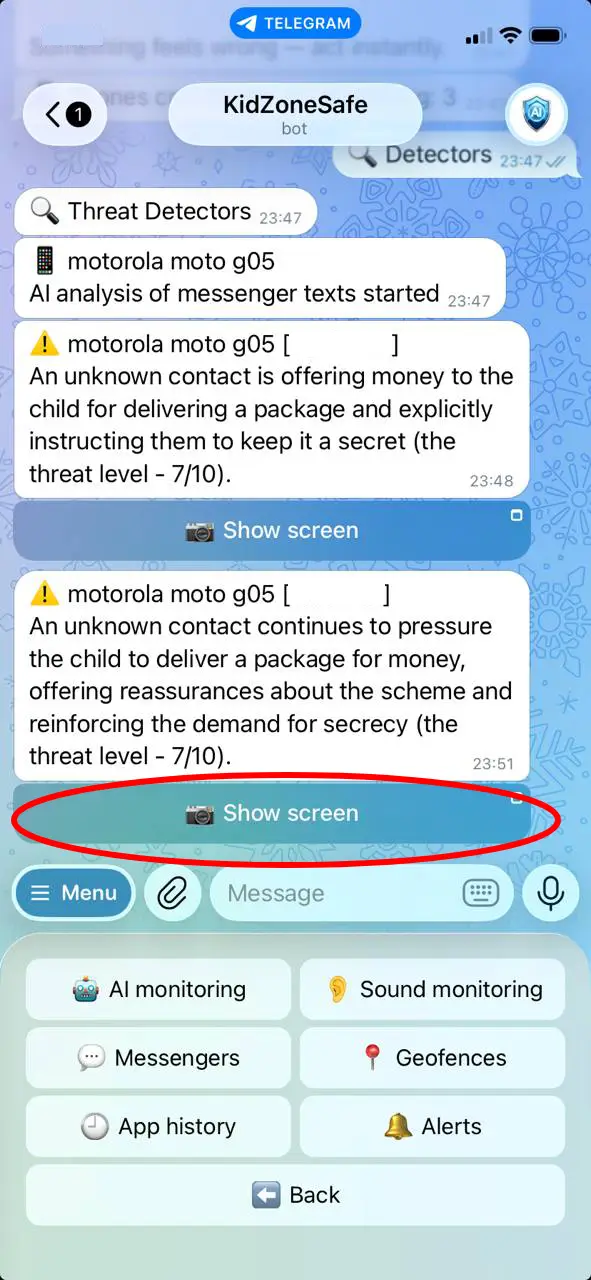
The same logic works for speech: an unknown adult, an invitation, insistence, a child's refusal being overridden. The conversation the child cannot report is exactly the one worth hearing.
What a useful alert contains
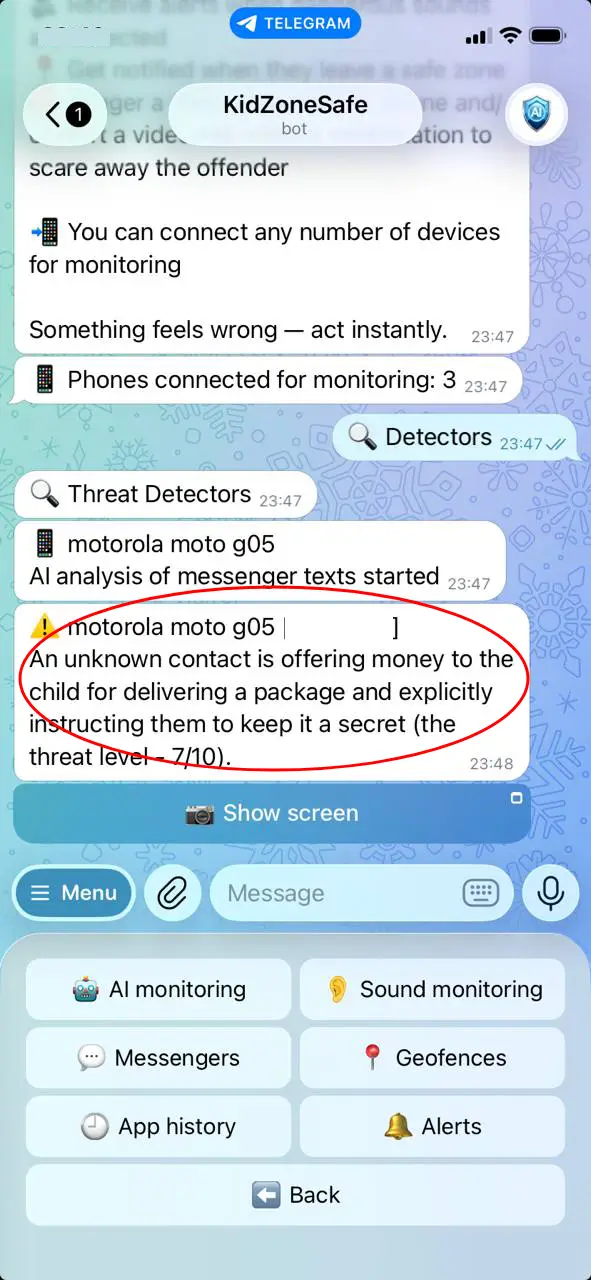
Four parts, no more: who (daughter, motorola moto g05), what ("an unknown adult demands secrecy"), how dangerous (level 8 of 10), and what to do (show screen, listen, intervene). A notification that says "activity detected" is noise; it gets muted, and a muted alert is worse than none, because it creates the illusion of protection.
Channels: the one you actually read
The best channel is not the most modern one, it is the one a parent notices at work, in a meeting, at night. The KidZoneSafe service sends the same event to a Telegram bot, a push on kidzonesafe.com, an SMS or a phone call. A call is not elegant, but for a level 9 alert at 23:40 it is the only channel that wakes a parent up.
Alert is not surveillance
A parent does not need to read every message. A parent needs to be told when a conversation stops being a conversation. This is also the only version a teenager tolerates: the alert is about people who lie to children, not about the child's private life with friends. That distinction is worth saying out loud at home — it is the difference between "my parents spy on me" and "my parents watch out for me".
Set up in ten minutes
- Install the Environment Control app on the child's phone — no rooting, no custom firmware.
- Create the account on kidzonesafe.com and choose the alert channels you really read; add a phone call for critical levels.
- Agree the rules at home: what the service checks, what it never touches, and what happens if something goes wrong.
- Test the chain once, together — so the first real alert is not the first time the child sees a parent look at the screen.
The chain that closes the gap
Detector → alert → live check → intervention. The detector notices the pattern while the conversation is still going: a messenger script, a stranger's voice, a school chat turning cruel. The alert reaches you in seconds through the channel you chose. You verify the context with live access — screen, camera, microphone — and if the child is in danger now, Intervene mode brings your voice into the phone at full volume, without the child answering.
A service does not replace the conversation you will have tonight. It replaces learning about it months later. Start free — the trial period is 5 days.