
 Monitoring
An Adult Asked Your Child to Deliver a Package — and to Keep It Secret
A friendly message that offers a child money is one of the most common ways minors are pulled into criminal schemes. It almost never looks like a crime: a small job, a quick payment, a package that just needs to be carried. The only condition is secrecy — and that condition is exactly what makes the scheme work.
How it starts: friendly, then paid, then secret
The pattern repeats. An unknown account writes to the child — often on Instagram, Telegram, WhatsApp or Snapchat. First a neutral message, then a compliment or a joke, then a request: carry a package, leave it at an address, hand it to a person. The money is small enough to look normal and large enough for a teenager to be interested.
Then comes the condition: do not tell your parents. From that moment the child is no longer a courier — the child is a hostage of the secret. If anything goes wrong, the same person has leverage: you already agreed, you will be the one to blame, I know your school.
Why children agree and then stay silent
- money they do not have to ask their parents for;
- the feeling of being chosen, adult and trusted;
- fear of punishment — they understand something is wrong, but not how serious it is;
- shame: admitting it means admitting they were naive;
- blackmail: threats to tell the school, the parents, the friends.
A child who is afraid of a scandal will hide the problem exactly as long as the adult keeps the reaction frightening. That is why the first conversation matters more than the first punishment.
What a threat detector sees that a parent cannot
Parents usually learn about the scheme when the package has already been delivered. A messenger threat detector works with the conversation itself — and it does not need to read every chat. It looks for the combination that appears in real recruiting: an offer of money, a task, and a demand for secrecy.
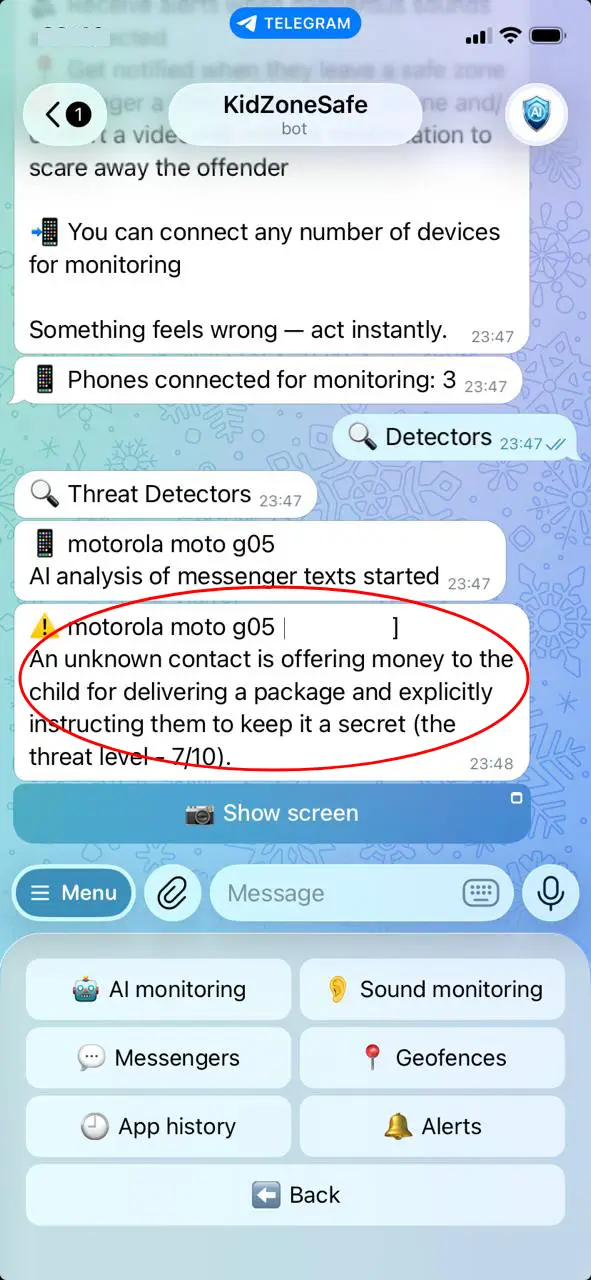
Then the detector evaluates the dynamics, not single phrases: the first message is an offer, the second is pressure, the third is a scheme with reassurance that everything is fine and nobody will know. That escalation is a pattern — and a pattern is detectable even when every separate sentence looks innocent.
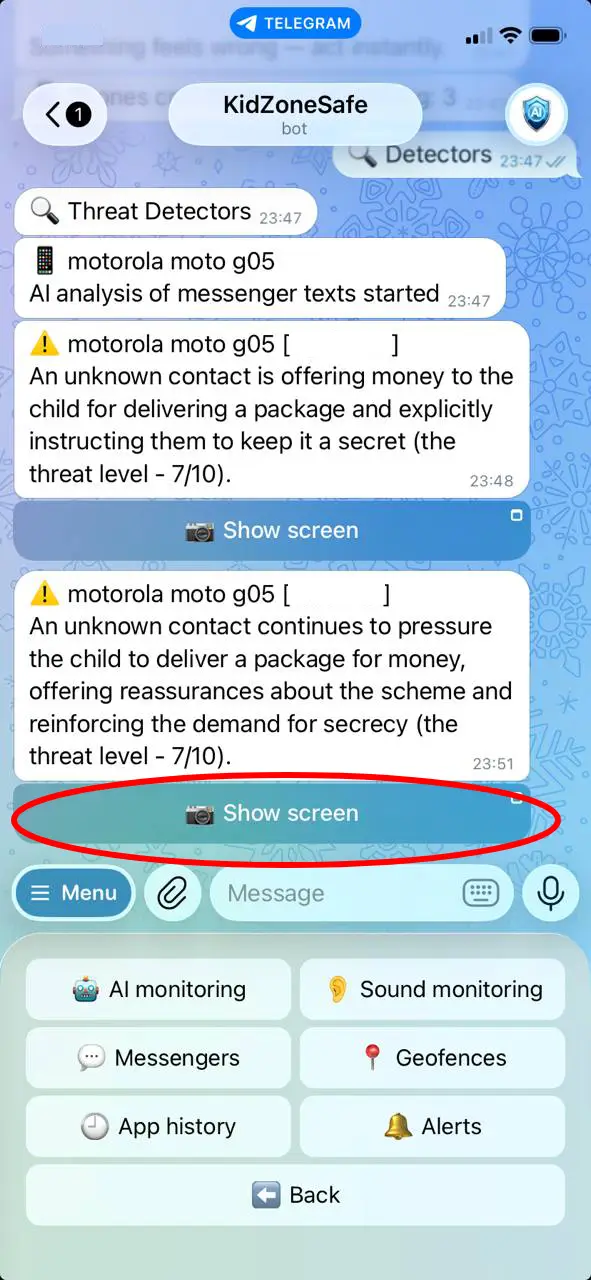
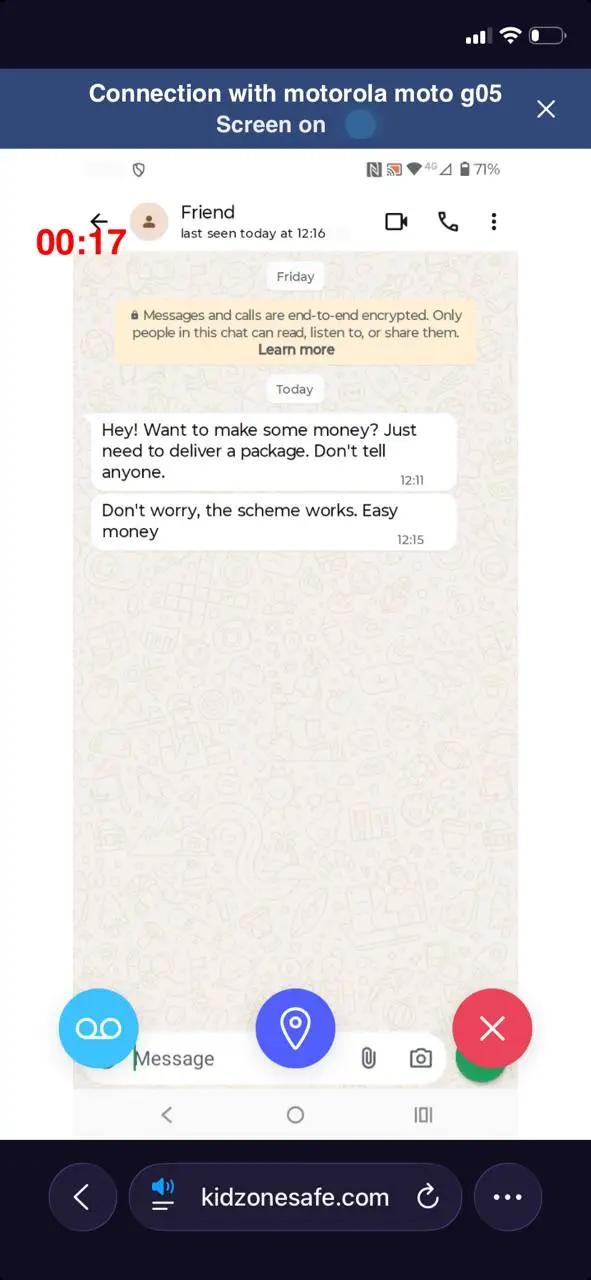
And it shows what the child actually sees — not a retelling, but the screen with the open chat.
First 24 hours: what to do, in order
- Do not start with punishment. Your goal is the full picture, and fear closes it immediately.
- Save the evidence before anything is deleted: screenshots of the chat, the profile of the contact, the payment details.
- Find out whether a package was already taken and where it is now. If it is already in your hands, do not move it — this is a police matter.
- Block the contact and stop all communication from the child account.
- Check for extortion: if the adult demands more, threatens the child or asks for photos, it is already a crime — contact the police, not the school chat.
- Explain the responsibility honestly. Children often believe that carrying a package is a small offence. It is not.
Two related reads: how cyberbullying escalates and dangerous online groups — the recruiting mechanics are similar.
Prevention: the conversation that actually works
The most effective protection is not a hidden app but a clear agreement: what you check, what you never touch, and what happens if something goes wrong. We described how to build such an agreement without a fight in Phone rules that actually work.
The chain that closes the gap
Detector → alert → live check → intervention. The messenger detector notices the pattern while the conversation is still going. The alert reaches you through the channel you chose: Telegram bot, push on kidzonesafe.com, SMS or a phone call. You verify the situation with live access — the child screen, camera or microphone — so you see the conversation instead of guessing. And if the child is in danger right now, Intervene mode lets your voice reach the phone immediately: the child hears you, and the adult on the other side understands that the child is not alone.
This does not replace talking to your child. It replaces finding out too late. Start free — the trial period is 5 days.