
 Monitoring
A Deepfake of Your Child: What Parents Can Actually Do
A deepfake is an image, video or voice clip that was generated or altered by software — often in under a minute, on a phone. When it targets a child, the goal is almost never money first: it is humiliation, leverage, or "revenge" for a refusal. The good news is that a fake is technically detectable, legally actionable and removable. The bad news is that the first thing most families do — forwarding it to prove it is fake — makes everything worse.
Source: NCMEC CyberTipline — reporting image-based abuse of a minor.
What a Deepfake Is — and What It Is Not
Modern tools swap a face onto another body, or synthesise a whole scene from a few photos taken from a public profile. The result looks convincing on a phone screen, especially when it is compressed by a messenger and viewed in three seconds between lessons. It is not a photograph of your child, and it is not evidence of anything your child did.
That distinction matters legally as well: in most jurisdictions a synthetic sexual image of a minor is treated as child sexual abuse material, regardless of whether a real child was photographed. You do not have to prove it is fake to have it removed or to report it — the platform and the hotline handle that. Your job is to preserve it, not to argue about it in a group chat.
How It Reaches Your Child
The usual route is not a hacker. It is a classmate with an app, a screenshot from a profile, and a group chat with fifty participants. Three scenarios repeat in reports: a refusal ("she will not send anything"), a breakup, or a fight in a school chat. In each case the fake is created to win an argument, and the spread is the point.
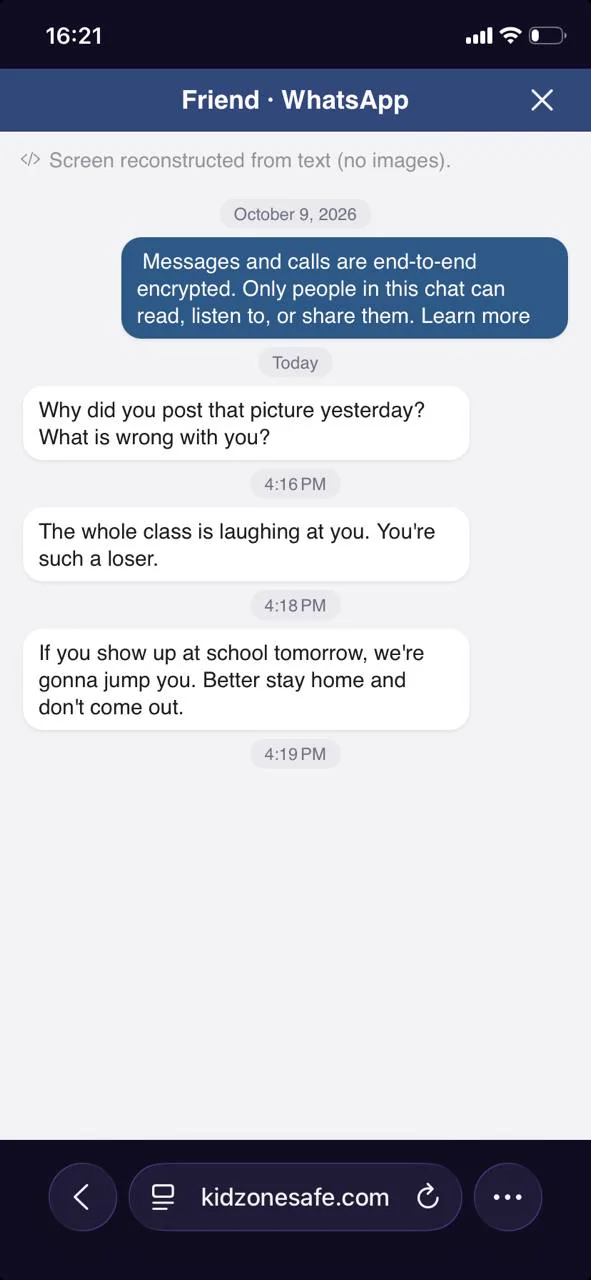
Signs Your Child May Be Targeted
undefined
- Sudden refusal to go to school — often the clearest signal, because the fake circulates where the child has to look people in the eye.
- Withdrawal from group chats — leaving chats, deleting the account, or going silent for days.
- Shame language — "everyone has seen it", "I want to disappear", "you will believe it too".
- Anger at one specific person — a named classmate or an ex, with no explanation of what happened.
- Constant checking of their own profile — searching their own name, refreshing comments, screenshotting threats.
The First 48 Hours: What to Do
- Do not forward it. Not to the school, not to the other parent, not to "prove" anything. Every forward creates a new copy and can be treated as distribution of abuse material — even by a protective parent.
- Preserve, do not collect. Take screenshots with the sender visible, note the time, the chat name, the number of participants. Keep them in a folder outside the phone.
- Report to the platform in the right category — "nudity or sexual content involving a minor", not "harassment". This changes the queue, the speed, and whether the account is removed.
- Tell the school in writing — a message to the form tutor and the head of year, with the facts and a request to stop the spread inside the school network. Written requests create a record if the school does nothing.
- Report to a hotline or police — CyberTipline or the local equivalent. This is not an overreaction: it is the only route that can trace the creator through the platform.
What Not to Do
Do not interrogate your child about what they "did" to deserve it — the fake is enough on its own, and there is nothing to deserve. Do not ask them to explain the images to relatives. Do not demand that they confront the classmate in public. And do not leave the phone in the child's hands for another night of reading the comments: the harm here is the loop of watching, not the file itself.

Where Monitoring Helps, and Where It Does Not
Monitoring will not detect a fake created on someone else's phone. What it does is shorten the window in which your child is alone with it: detectors flag threats and escalation in chats, and live verification of what is actually happening on the screen turns a vague fear into facts. Start with how grooming leads to coercion — grooming warning signs — and with what to do if images are already being used as blackmail (sextortion: the first hour). The chain we build for parents is detect → verify → intervene (how the model works), and every tool in it is only useful if it makes the conversation earlier, not louder. For the wider picture of school-based cruelty, see how to protect a child from cyberbullying.