
 Monitoring
An Adult Asked My Child to Keep a Secret: What It Means
A request for secrecy from an adult is the single most reliable sign that a child is being manipulated. Healthy adults do not ask a child to hide a friendship, a gift, a chat or a meeting from parents — an adult who needs a secret has something to hide, and in cases involving children that something is usually a crime in progress. If your child has already been told to keep quiet, the first hours matter far more than the next months: what you do now decides whether the child tells you the rest.
What "keep it a secret" actually sounds like
The word "secret" is rarely used. Real grooming hides the request inside something that sounds flattering or exciting: this is just between us, your parents would not understand, they will only get angry and ban your phone, nobody needs to know about our game, delete this chat after reading. Sometimes the demand is technical rather than emotional — a second account, a hidden app, a phone turned face down when a parent enters the room.
Source: eSafety Commissioner (Australia) — Child grooming and unwanted contact.
Every one of these phrases has the same function: to move the relationship out of the area where adults can see it. That is why the request is a warning sign on its own, even before anything illegal has happened.
Why children agree to keep the secret
- They were chosen. Attention from an older person feels like importance, especially for a child who feels invisible at school.
- They are embarrassed. Many children understand that something is off but not how serious it is, and admitting it feels like admitting they were stupid.
- They are afraid of the consequences. The adult usually plants the fear first: "if your parents find out, you will lose your phone, and I will tell everyone what you sent me".
- They are loyal. After weeks of kindness and gifts the child may genuinely believe the adult is a friend who is misunderstood.
- They were threatened — with exposure, with harm to the family, or with police.
The trap closes precisely because the child is now protecting the adult. Silence is no longer a choice the child made; it is a debt the child believes they owe.
Warning signs a parent can actually see
There is no single sign that proves grooming, but a cluster of small changes usually appears weeks before anything dramatic happens.
- the child hides the screen, tilts the phone away or goes quiet when an adult comes close;
- new gifts, money, top-ups, in-game items or a phone that suddenly appeared;
- a new "friend" who is never named as a classmate, or an online friend described only as "someone";
- withdrawal from the family, irritability after using the phone, secrecy about where they were;
- a second account, a hidden app, or notifications switched off;
- sexual or adult themes appearing in the child's language that were not there before;
- reluctance to talk about one specific person — the child changes the subject quickly.
One sign means a conversation. Three or four together mean the child is already inside a situation.
An adult contacted my child — what to do first
- Do not start with punishment or with confiscating the phone. The adult has already told the child that parents will overreact; a screaming parent proves it and locks the story away forever.
- Preserve the evidence before anything else. Screenshots of the chat, the profile, the phone number, the payment details. Do not delete the conversation and do not let the child delete it "to be safe".
- Ask open questions about the person, not the crime. "How did you two start talking?" works better than "did he ask you for photos?".
- Stop the contact. Block the account from the child's device once the evidence is saved. Do not confront the adult from the child's profile.
- Report it. In the EU and the UK a report to the platform and to the police (or the national reporting line) is the correct step when an adult has asked a child for photos, a meeting or secrecy about sexual content. In the US, the NCMEC CyberTipline is designed for exactly this.
- Tell the school only if the contact came through school channels — otherwise the story spreads faster than the investigation.
- Check whether anything was already sent or paid. Money, gift cards and "loans" are how blackmail starts later.
The conversation that keeps the door open
Children disclose to adults who react calmly. The script that works is short and boring on purpose: "Thank you for telling me. You are not in trouble. I am not angry with you. I am angry at the adult, and I will handle it — you do not have to talk to him again."
Then separate the two things the child is afraid of: the punishment and the exposure. Say clearly what will happen next, step by step, and keep the promise. A child who was believed once will come back with the second half of the story, which is usually the part that matters.
Why a parental control app cannot see this — and what can
Screen-time limits and app blockers do not read conversations. A groomer works inside normal apps: Instagram, Telegram, WhatsApp, Snapchat, Roblox, Discord, a game chat. Nothing there looks like a blocked app, because nothing there is blocked — the danger is the pattern of the conversation itself.
That is the case for a messenger detector: it looks not at single words but at the dynamics. A friendly message, then a compliment, then a request for secrecy, then pressure — the escalation is a pattern, and a pattern is detectable even when every sentence alone looks innocent. When the pattern appears, the parent gets an alert while the conversation is still happening.
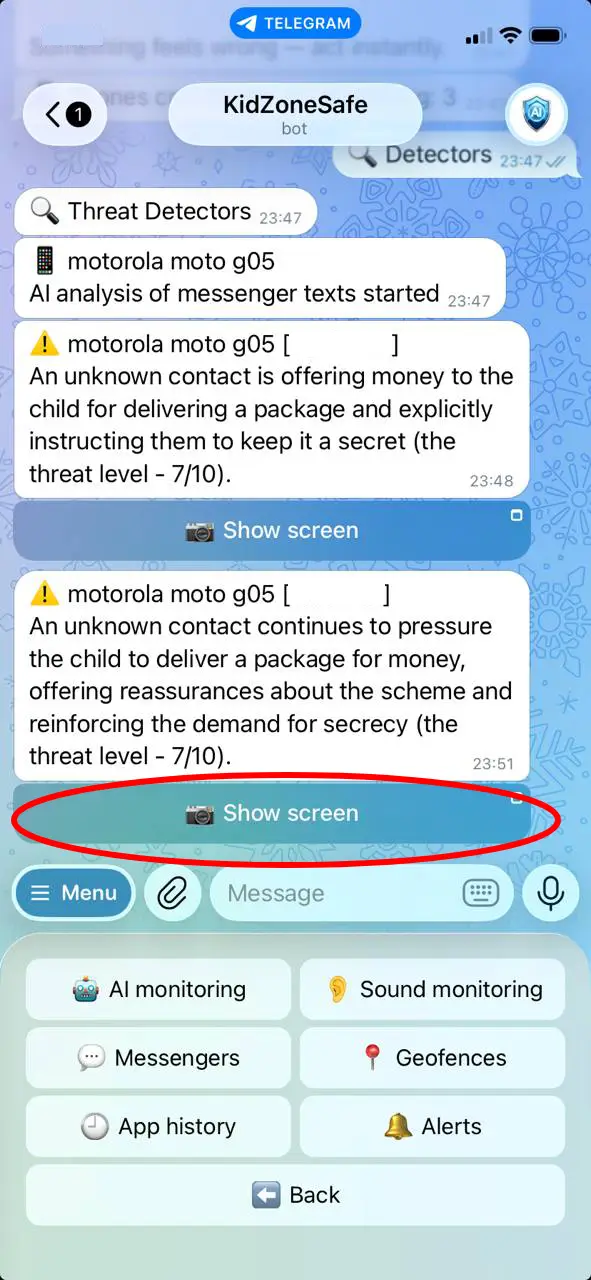
Then the parent verifies the context instead of guessing: the live screen of the child's phone shows the actual chat, and the camera or microphone show what is happening around the child. That is the difference between a suspicion and knowledge.
The chain that closes the gap
Detector → alert → live check → intervention. The messenger detector notices the pattern while the conversation is still going. The alert reaches the parent through the chosen channel: Telegram bot, push on kidzonesafe.com, SMS or a phone call. The parent checks the situation with live access — screen, camera or microphone — and if the child is in danger right now, Intervene mode puts the parent's voice into the child's phone at full volume, without the child having to answer.
This does not replace the conversation you are going to have tonight. It replaces learning about the secret months later, from a stranger. Start free — the trial period is 5 days.
Related reading: signs of online grooming and how to protect a child from online predators.