
 Monitoring
Someone Asked My Child to Get in the Car: First-Hour Plan
A stranger asking a child into a car is one of the most rehearsed crimes there is — and almost never starts with force. It starts with a friendly reason that a child can accept without feeling threatened: a lift home, a lost dog, "your mother asked me to pick you up", a package to carry. The child is not naive for agreeing; the script was designed by an adult to sound normal. What protects a child is not a lecture about strangers, but a short, practised rule and an adult who finds out within minutes.
How the lure actually works
Police and child-protection organisations describe the same five openings year after year:
- Authority: "Your mum sent me", "I work with your dad", "the teacher asked me to drive you".
- Help: a lost dog, a dropped bag, help carrying something to the car, directions to an address.
- Reward: sweets, money, a lift instead of a bus, a chance to see something.
- Familiarity: a few greetings over several days — the person becomes "the man from the corner", not a stranger.
- Urgency: "quick, get in, it's raining, we'll be late".
Notice what these have in common: none of them looks like an attack. The crime lives in the moment after the door closes, and by then it is too late to teach a rule.
Why "don't talk to strangers" does not work
The rule fails for three practical reasons. Children cannot reliably tell a stranger from a safe adult, especially when the adult explains who he is. Most child abductions are not committed by a person the child has never seen. And a child who has been trained to be polite to adults has been trained against the rule.
Source: Childnet International — advice for parents and carers.
What works instead is a decision made before the situation: a family code word, a fixed rule about who may ever collect the child, and an explicit permission to be rude. A useful line for a child to memorise: "I don't go with anyone my parents did not tell me about. I can check right now."
What to teach a child in ten minutes
- A code word that only the family knows. Anyone who claims to come from the parents must say it.
- A distance rule: talk from at least three steps away, never approach the car, never stand next to the window.
- A refusal script: "No. I'm calling my mum." Said loudly, not politely.
- Never get in, never go to a second location — not for a pet, not for a phone, not for help.
- Report it immediately, even if nothing happened. The report is not a complaint; it is information.
- Take a photo or memorise the plate only if it can be done from a distance without approaching.
The first hour after your child told you
- Write down the details while they are fresh: time, place, description, car, plate, exact words, direction of travel.
- Do not go looking for the person yourself. This is the one situation where a parent's anger can destroy evidence and create a new danger.
- Call the police the same day. In most countries an attempt to lure a child into a vehicle is already an offence, and a pattern across several reports is what actually gets a patrol to the street.
- Tell the school and the other parents through the official channel, so the message reaches them before a rumour does.
- Check whether it was the first time. Children often mention only the last incident; ask about "any other time someone talked to you".
- Change the route for a couple of weeks and make the walk home a shared one.
What nobody hears without help: the conversation itself
A lure is spoken, not typed. There is no chat log, no screenshot, no message to show a parent. The only record is sound around the child's phone — and that is exactly what a sound and conversation detector analyses. It does not record everything; it looks for the pattern: an adult stranger, an invitation, insistence, a child's refusal being overridden.

When the pattern appears, the parent gets an alert within seconds — not a weekly report. That is the difference between a police report on Monday and an adult voice in the child's phone while the car door is still open.
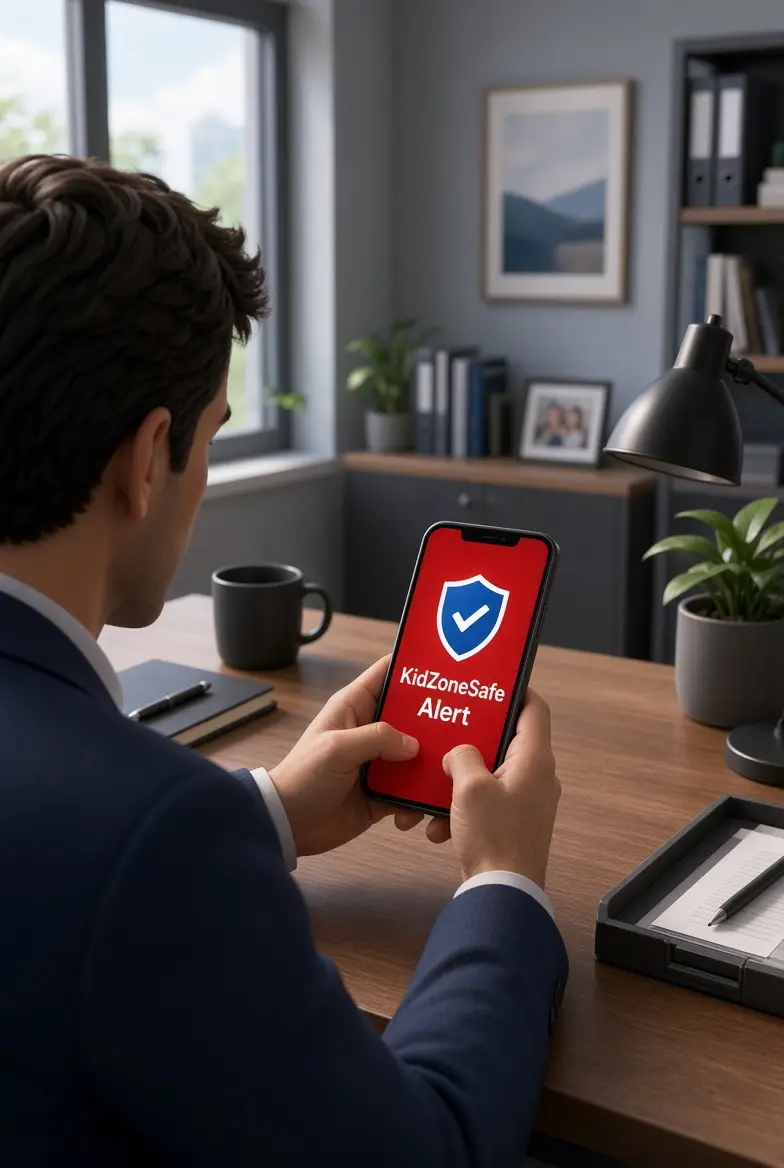
Real-time alerts that a parent can act on
A useful alert has three properties: it arrives within seconds, it names the danger instead of raw data, and it comes with a way to act. An alert that says "movement detected" at 21:40 is noise. An alert that says "an unknown adult is trying to get your daughter into a car, level 8 of 10" is a decision, and behind it there is always a live view and a way to intervene.
Two related reads: what happens when a child shares location and Intervene mode — the tool that turns an alert into a voice next to your child.
The chain that closes the gap
Detector → alert → live check → intervention. The sound detector notices the lure while it is being spoken. The alert arrives through the chosen channel: Telegram bot, push on kidzonesafe.com, SMS or a call. The parent verifies with live access — microphone, camera, screen — and if the situation is real, Intervene mode brings the parent's voice into the child's phone at maximum volume without the child answering.
Nothing replaces teaching the rule. The chain only guarantees that you find out while the rule is being tested. Start free — the trial period is 5 days.