
 Monitoring
Parental Control for Social Media Monitoring: What Actually Works
Every week a parent searches "parental control for social media monitoring" and expects a dashboard with their child's Instagram and Snapchat messages. That product does not exist, and it cannot: the platforms do not expose private messages to third parties, and any app that claims to read them is either lying or using a rooted phone. What does work is a three-layer approach — filtering what is blocked, detecting danger in what arrives on the device, and verifying the context in seconds when an alert fires.
Source: Common Sense Media — parents' ultimate guide to social media.
What Parents Actually Want When They Say "Monitoring"
In practice it means three different things, often at once: "do not let my child see this content", "tell me if something bad is happening", and "let me look at the screen when I am worried". Those are three different technical problems, and confusing them is why most parental control apps disappoint: they sell one feature and imply the other two.
The expectation is also shaped by numbers parents hear about. Research summaries from psychological associations consistently find that the effect of social media on adolescent wellbeing is real but not uniform — it depends far more on what happens in the child's life than on minutes of screen time. That is precisely why a report of "3 h 20 min" answers nothing, and a signal about an actual dangerous conversation answers everything.
What the Platforms Will and Will Not Give You
No major social network offers a parental API that reads a child's private messages. What they do offer is in-app supervision (time limits, who can message your child, who can see posts), reporting flows, and age-related defaults. That is real value, but it is a fence, not a window: it tells you the rules were set, not what is being said. The only place where the actual conversation exists is the child's device — which is why any honest "social media monitoring" happens on the phone, not in the platform's cloud.
The Three Layers That Actually Cover the Risk
- Layer 1 — fence. Platform supervision and on-device filters: age settings, who may write to the child, blocked categories of sites and apps. Stops the obvious, does nothing about what is already inside an allowed app.
- Layer 2 — detection. On-device analysis of messages in any messenger (not just one brand), links to dangerous groups, and sound around the phone in the school-break hours the parent sets. This is what turns "I hope nothing is happening" into an alert.
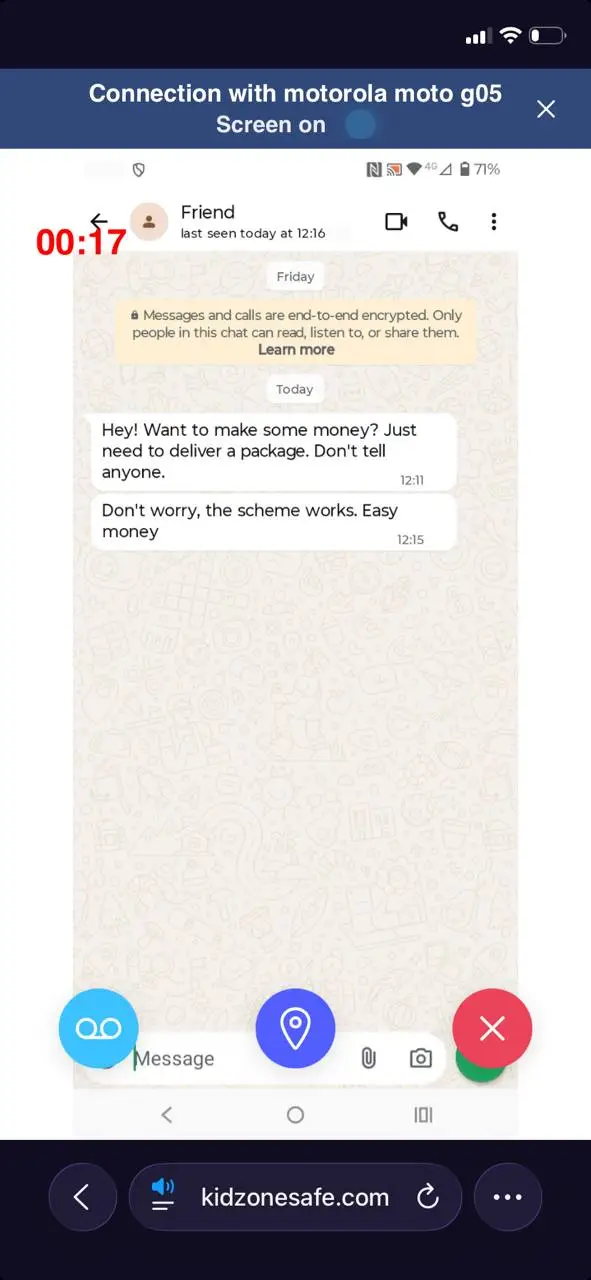
- Layer 3 — verification. Live screen access and a one-way video call without the child's confirmation: the fastest way to establish context after an alert, when the child is frightened, running, or simply does not answer.
Layers two and three are the ones people mean when they ask about monitoring social media, and they are the ones that work regardless of which network is fashionable this year. They are also the ones that require a conversation, because they run on the child's device: control versus protection explains why we frame it that way.
Privacy, Trust and the Line You Should Not Cross
Secret surveillance fails predictably. A teenager who finds a hidden app removes it, creates a second account, or moves the conversation to a device you do not control — and the parent loses both the signal and the trust at the same moment. The workable rule is transparency: the child knows the app exists, knows which detectors are on and when sound analysis runs, and knows that a live check can happen without their confirmation in a real emergency. Our long-form guide on monitoring teenagers without losing trust and the age-by-age guide go deeper; the principle is the same at every age — consent where possible, transparency always, and a written agreement about what is checked and when (phone rules agreement).
undefined
undefined
Setup in Six Steps
- Set the platform fences first. In each app the child uses, turn on supervision, restrict who can send messages, and review the privacy defaults together — not for them.
- Agree on the detectors in one conversation — which messengers are analysed, which hours are covered, what threshold triggers an alert, and who receives it.
- Test the alert path once, on a harmless trigger, so the first real alert is not also a technical surprise.
- Decide what "verification" means in advance: live screen, camera, or a one-way call — and tell the child the rule before it is ever used.
- Write the agreement down in one page: what is monitored, what is never read, how long data stays, and how the child can raise a complaint.
- Review it every three months. Monitoring for a 10-year-old and for a 15-year-old are different products. Start from how remote phone monitoring actually works and adjust as the child grows.
- Common Sense Media — parents' ultimate guide to social media
- American Psychological Association — youth and social media