
 Monitoring
Dangers of Instagram for Children: What Parents Miss
Instagram is not dangerous because of screen time. It is dangerous in three specific patterns: an adult who starts a friendly DM, a second account your child keeps hidden, and a screenshot used as leverage. Each one has a short window when a parent can still change the outcome — and that window is measured in hours, not months.
What Actually Happens There
Instagram is built for discovery: strangers can find a child through a comment, a shared reel, a hashtag or a suggested account. The platform is public by default for anyone with an open profile, and a teenager's profile is usually open because that is how you get followers.
That means the first contact is almost never a hack. It is a comment, a like, then a DM that starts with a compliment. From the parent's side it looks like nothing: the phone is in the child's hands, the screen shows the usual feed, and nothing is flagged as a problem.
Three Schemes Worth Knowing by Name
- The friendly DM. An adult writes in the child's language, compliments the photos, asks for a "small favour" — a photo, a voice message, a link. It usually takes several weeks before anything sexual is asked. That long preparation is exactly what makes it detectable.
- The hidden second account. A "finsta" or a second profile that the parents do not know about. It exists for one reason: to post and talk where no adult looks. On the same phone, in the same app, with a different login.
- Screenshot blackmail. Anything sent once — a photo, a message, a selfie in a swimsuit — can be screenshotted and used as leverage ("send more or I send this to your class"). The demand comes fast, often within an hour of the first image.
What a Parent Can Actually See
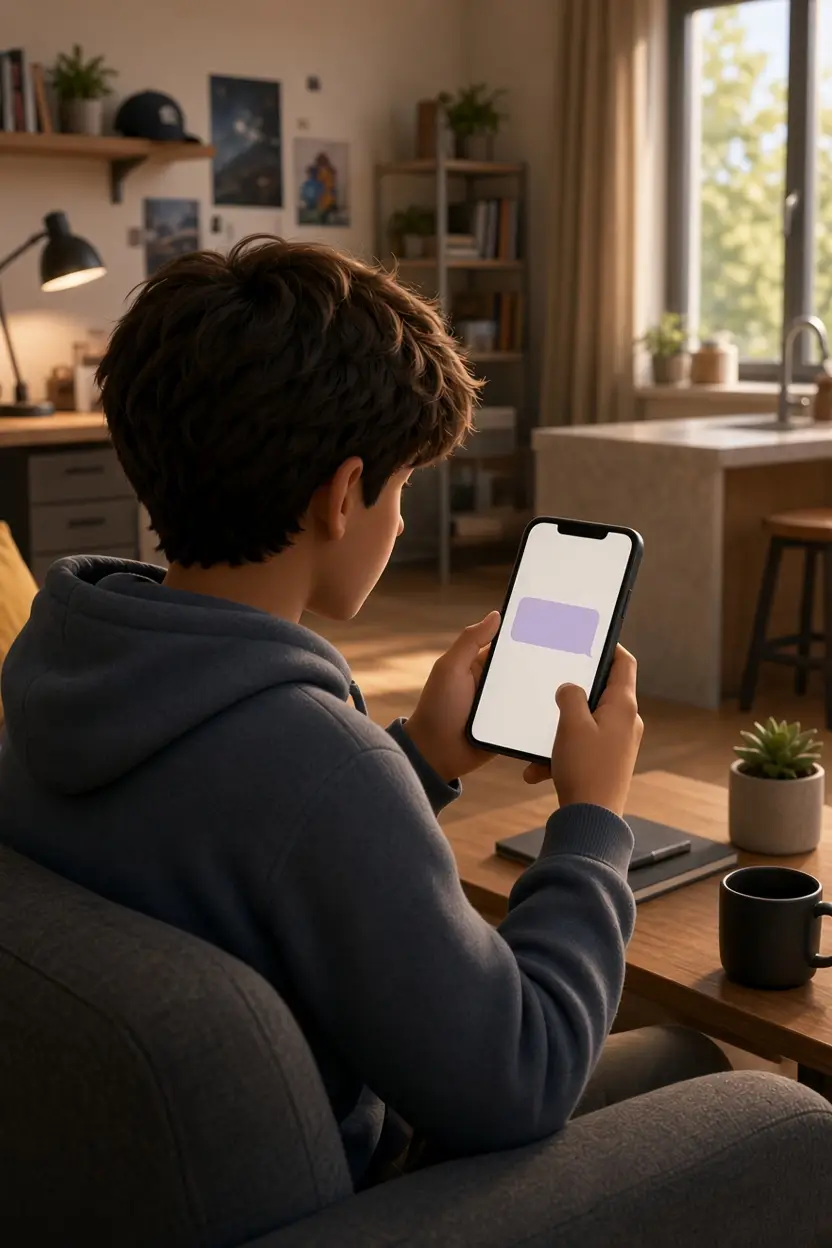
Parental controls on Instagram itself mainly limit time and hide some content — they do not show you who is writing to your child. That is the gap: settings answer "how long", while the risk lives in "who and about what". So the useful setup has two layers. First, in the app: a private account, restricted messages from people the child does not follow, and review of follower requests together. Second, outside the app: something that shows the conversation itself, not just the minutes.
The First 24 Hours After Something Happens
- Do not take the phone away as punishment. It is the only evidence and the only channel to the person writing. Losing it teaches the child to hide the next one better.
- Save what exists. Screenshots with the nickname and the time visible, the profile link, the message text. Not in the gallery — in a folder outside the phone.
- Report inside the app in the right category — "nudity or sexual content involving a minor", not "harassment". The queue and the speed are different.
- Block, then report the account, in that order: blocking stops the contact immediately, reporting creates the record.
- Report outside the app too — the local hotline or the platform's child-safety form. For image-based abuse this is the only route that can trace the sender.
What Not to Do
Do not read the whole chat out loud in front of the family — the child will shut down and you will lose the next conversation too. Do not demand the password "forever": it is a one-time gesture and it will be changed the same evening. Do not message the adult yourself — it warns them and gives them time to delete everything. And do not treat it as a parenting failure: the scheme is designed for adults to sound normal to a teenager.

Where Monitoring Helps and Where It Does Not
No app will read Instagram for you and decide what matters: the platform does not expose the conversation to third-party tools. What does help is catching the moment when a conversation starts to escalate — and being able to look at the screen live instead of guessing. Our model is detect → verify → intervene (how it works). If an adult is already asking for photos, go straight to grooming warning signs and a child was asked for nudes. If images are already used as leverage — sextortion: the first hour. For the wider comparison of platforms, see TikTok dangers and social media monitoring.
Why this is protection, not just control
Most of this page is about "Dangers of Instagram for Children: What Parents Miss". The wider point matters more: rules and screen-time limits answer "how long and where", but they do not see the moment when something is actually happening. KidZoneSafe works one level below control — on the situation itself.
The chain is the same every time: a detector notices a pattern (a dangerous conversation, a sound, a place, a missing answer), the parent verifies it through the live screen or camera in seconds, and only then intervenes — a voice through the child's speaker, a siren, or a call to the school or the police. The child does not have to press anything.
- First, the alert arrives with a reason and a threat level — not just "something happened".
- Then the parent checks the evidence in under a minute, not the next morning.
- Finally, the parent acts while it is still the moment — because afterwards only a report remains.
That is the difference between a product that counts minutes and a product that is there when it matters.
- ConnectSafely — parent guides
- Common Sense Media — parental controls guide
- eSafety Commissioner — cyberbullying advice