
 Monitoring
Your Child Was Asked for Nudes: What to Do in the First Hour
Being asked for nudes is not a rare event and it is not a sign that something is wrong with your child. It is a script that adults and teenagers run on purpose: build trust, normalise, ask, then use the result. What decides the outcome is not whether you find out, but what you do in the first hour after you do.
What Actually Happened
The request almost never comes from a stranger who "hacked" anything. It comes after days or weeks of ordinary conversation: a compliment, a shared joke, a promise that "nobody will see", a story about how "everyone does it". By the time the question is asked, the child has already been taught that refusing would be rude.
If your child already sent something, the same logic applies: they were not stupid and they were not asking for it. They were trusted, pressured or scared, often all three in one evening. The photo is a file; the real problem is the person who asked for it and the leverage they now hold.
Why "Just Delete It" Makes It Worse
Deleting the chat removes the evidence, and evidence is the only thing that lets a platform, a hotline or the police act. It also removes the possibility of proving what was demanded, when, and by whom. Worse, panicked deletion by a parent teaches the child that the topic is dangerous at home — and the next request will not be mentioned at all. So the first rule is the opposite of instinct: keep everything, then decide together what to do with it.
The First Hour: What to Do
- Stay calm and say one sentence out loud: "You are not in trouble. We will deal with this together." Everything else depends on this sentence.
- Do not delete the chat and do not block yet. Blocking is step four, not step one: first you need the nickname, the profile link and the message text.
- Save the evidence outside the phone. Screenshots where the nickname and the time are visible, the profile URL, the exact wording of the request. Photos of the screen are fine; a folder in your own cloud is fine.
- Block and report in the app, in the category "nudity or sexual content involving a minor". Then report outside the app — CyberTipline or the local hotline — especially if the person is an adult, asks for more, or threatens.
- Do not contact the person yourself. A parent's message warns them and gives them time to delete the account and everything in it.
If Something Was Already Sent
This is the part most parents fear, and it is the part where calm action still works. An image that exists somewhere can be reported, removed and, for minors, treated as abuse material — regardless of who sent it. What makes it spread is panic-driven forwarding, so the priority is to stop any further sharing from your side and to get a formal record started.
- Ask one question, without detail: "Did you send anything?" Then stop asking for details; the screenshots already have them.
- Write down the facts, once: date, time, nickname, platform, what was demanded. One page. This page is what you will paste into every form.
- Report inside the platform and outside it — the platform form plus CyberTipline or a national hotline. For an adult sender this is a criminal matter, not a school matter.
- Tell the school only what is needed, in writing, if classmates are involved. Ask for a written response and a plan to stop the spread.
- Do not ask the child to confront anyone and do not forward the image "to prove" it exists — that is distribution, even with good intentions.
What to Say to Your Child
- "You are not in trouble, and I am not going to take your phone away because of this."
- "The person who asked did something wrong. Not you."
- "We are not going to read it all together right now. I need two screenshots, and then we stop."
- "If something like this happens again, I want to be the first person you tell — not the last."
- "Nothing about this is a reason to be ashamed in front of me."
Where Monitoring Helps, and Its Limits
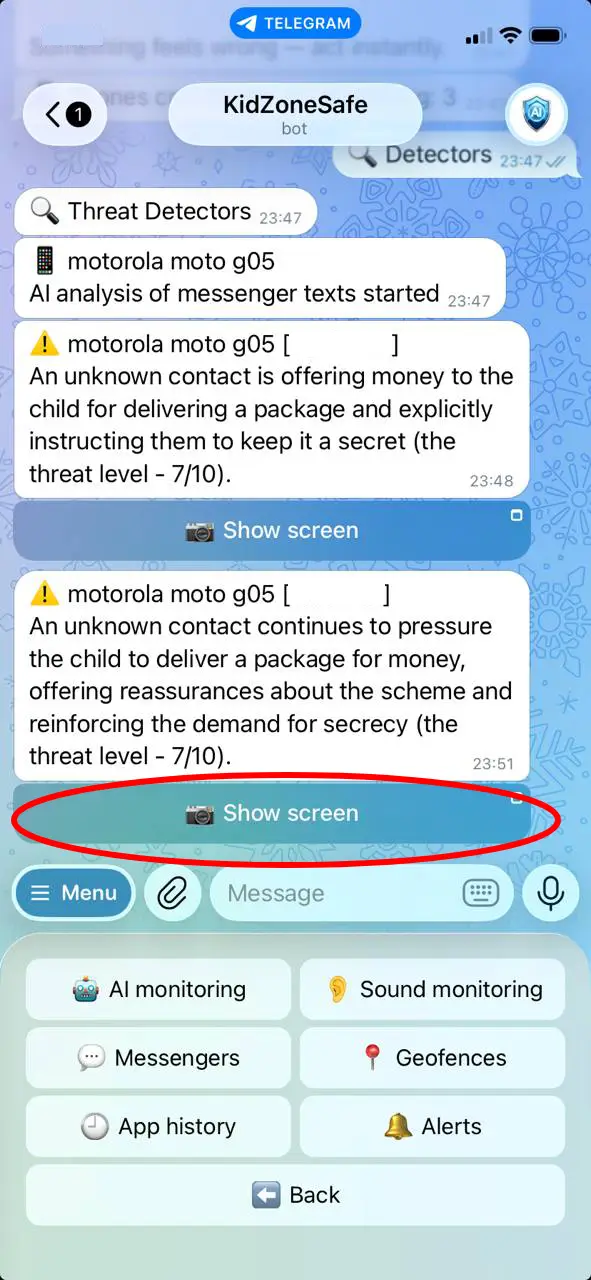
No tool can undo a request that was already sent — that is why the conversation matters more than the software. What monitoring does is shorten the interval between "something started" and "a parent knows": detectors flag escalation in chats, and live verification shows what is actually on the screen instead of what a child chooses to describe. Our model is detect → verify → intervene (how it works). For the adult version of this scheme read grooming warning signs; if the photos are already used as leverage — sextortion: the first hour. For the platform context: dangers of Instagram, and for synthetic images deepfakes of a child.
Why this is protection, not just control
Most of this page is about "Your Child Was Asked for Nudes: What to Do in the First Hour". The wider point matters more: rules and screen-time limits answer "how long and where", but they do not see the moment when something is actually happening. KidZoneSafe works one level below control — on the situation itself.
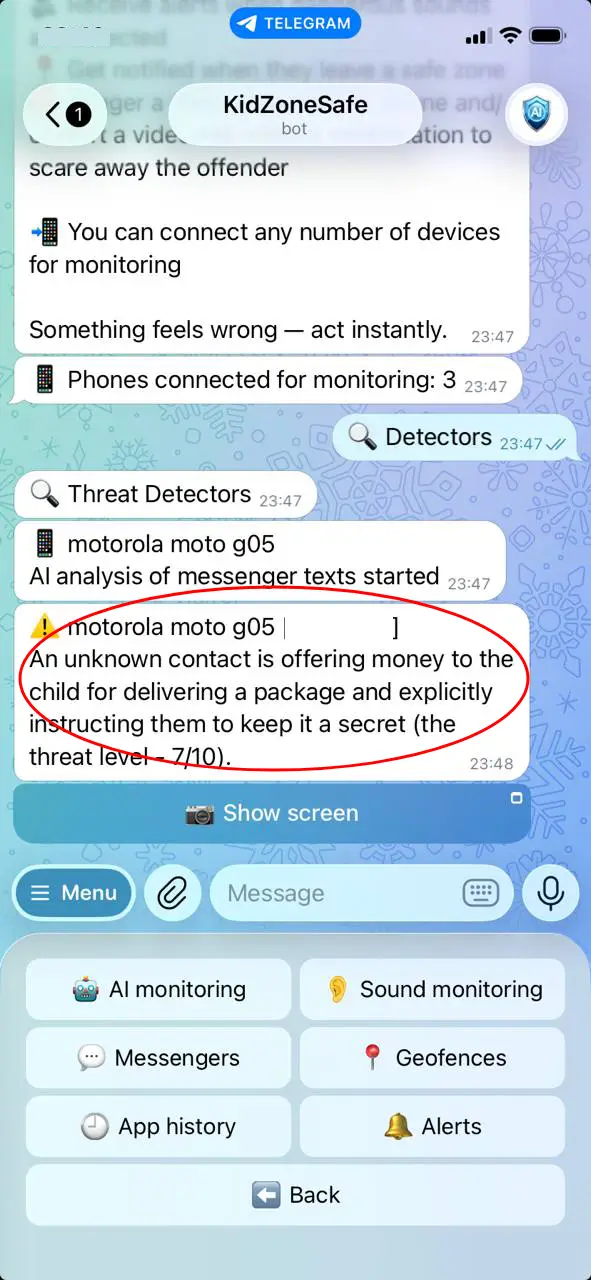
The chain is the same every time: a detector notices a pattern (a dangerous conversation, a sound, a place, a missing answer), the parent verifies it through the live screen or camera in seconds, and only then intervenes — a voice through the child's speaker, a siren, or a call to the school or the police. The child does not have to press anything.
- First, the alert arrives with a reason and a threat level — not just "something happened".
- Then the parent checks the evidence in under a minute, not the next morning.
- Finally, the parent acts while it is still the moment — because afterwards only a report remains.
That is the difference between a product that counts minutes and a product that is there when it matters.